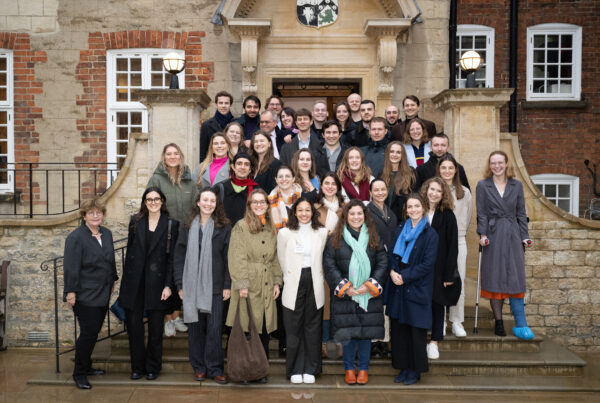
Classics Colloquium, October 2011

Tags:
21/10/2011 - 00:00
22/10/2011 - 23:59
Etc/GMT
Zeus and Hermes - The Strangers in the VillageZeus and Hermes -
The Strangers in the Village

Tenth Classics Colloquium:
Strangers and Friends

University of Helsinki

The theme for the 2011 Classics Colloquium – the tenth in our series – was Strangers and Friends, hosted by the University of Helsinki on October 21st - 22nd. Classics graduate scholars at member universities of the Europaeum and leading academic experts came together to present their papers for discussion and critique by fellow scholars. This year Helsinki welcomed graduates from Paris, Oxford, Bologna, Bonn, Krakow, Prague, Madrid and Leiden and young scholars from Oxford and Paris. Click here for a full list of participants.

Some of the themes covered included the impacts of Roman imperialism, war, city life, culture and religion and myth. Click here for Programme and List of Abstracts.


Programme:

Friday 21st October - All sessions in the Runeberg Hall in the Main Building

15.00 Welcome on behalf of University of Helsinki
Professor Olli Salomies, Professor of Latin

15:05-16:00 Opening Lecture
Chair: Professor Olli Salomies, University of Helsinki
Friend and Stranger, Friend or Foe: the hospes in Roman foundation-legends

  • Dr Donncha O’Rourke, University of Oxford,
    Discussants: Michiel Verheij (Leiden), Pavel Nyvlt (Prague)

16.00-17:30 Session I – Impacts from Roman Imperialism
Chair: Professor Mika Kajava, University of Helsinki

  • Kamil Kopij (Krakow): Few words on Roman Provincial Clientele in the Late Republic
    Discussant: Lucy Jackson (Oxford)
  • Mattia Vitelli Casella (Bologna): The inhabitants of the world borders in Strabo
    Discussant: Saskia Peels (Leiden)
  • Maria Victoria Vaello (Madrid): Nero at the Olympic Games
    Discussant: Kai Juntunen (Helsinki)

17.45-18:45 Session II – impacts from War
Chair: Dr Dimitri El Murr, Paris 1 University

  • Nadine Siepe (Bonn): Hannibal of Cathage in Silius: stranger and enemy and friend?
    Discussant: Maria Victoria Vaello (Madrid)
  • Kai Juntunen (Helsinki): From Foes to Friends? The Involuntary Military Service in the Roman Irregular Forces from the Second to Third Century CE
    Discussant: Katja Varakas (Helsinki)

18.45-20:00 Rector’s Reception
Hosted by Vice Rector, University of Helsinki, Prof. Ulla-Maija Forsberg

Saturday 22nd October - All sessions in the Institutum Classicum, Unioninkatu 40 A

9.30-11.00 Session III –Impacts from City Life in Athens
Chair: Dr Donncha O’Rourke, University of Oxford

  • Matteo Zaccarini (Bologna): Xenia and philolaconism in Cimonian Athens
    Discussant: Nadine Siepe (Bonn)
  • Pavel Nyvlt (Prague): Theramenes and Hetaeries in 404 BC: Both Friends and Enemies
    Discussant: Valentina Rosa (Bologna)
  • Petra Janouchova (Prague): Thracians in Athens: friends or strangers?
    Discussant: Caterina Franchi (Oxford)

11.30-13.00Session IV – Impacts from cultural and social Relations
Chair: Dr Dimitri El Murr, Paris 1 University

  • Barbara Fero (Krakow): A tale to tell: the character of Phoinix in the Embassy to Achilles
  • Caterina Franchi (Oxford): "And for me I keep only hope." Alexander and the hetairoi
    Discusant: Michiel Verheij (Leiden)
  • Katja Varakas (Helsinki): Representations of porters: friends or strangers?
    Discussant: Petra Janouchova (Prague)

14.00-15.00 Lecture:
Chair: Professor Leena Pietila-Castren, University of Helsinki

  • Dr Dimitri El Murr, Paris 1 University Friendship in Plato’s republic
    Discussants: Lucy Jackson (Oxford), Nadine Siepe (Bonn)

15.00-16.30 Session V - Greek Tragedy and concepts of friendship
Chair: Professor Mika Kajava, University of Helsinki

  • Michiel Verheij (Leiden): Hospitality & Homicide
    Discussant: Pavel Nyvlt (Prague)
  • Valentina Rosa (Bologna): 'Xenia' ambiguity and corrupted 'philia' through Europides' Alcestis
    Discussant: Kamil Kopij (Krakow)
  • Lucy Jackson (Oxford): "Who goes there?" Rhesus: Friend or Foe?
    Discussant: Matteo Zaccarini (Bologna)

16.50-17.50 Session VI - Impacts from Religion and Myth
Chair: Professor Olli Salomies, University of Helsinki

  • Sergio Lopez Molina (Madrid): Ino-Leucothea, benefactor on Greek Mythology
  • Saskia Peels (Leiden): Tragic debates on supplication
    Discussant: Petra Janouchova (Prague)

17.50-18.20 General Discussion & Conclusions
Discussants: Professor Salomies, Professor Pietila-Castren, Dr Flather


Speaker Biographies:

Dr Dimitri EL MURR is Lecturer in Ancient Philosophy at the University of Paris 1 Panthéon-Sorbonne and a Junior Member of the Institut universitaire de France. His research area is ancient philosophy, especially Socrates and Plato. He has launched in 2010 a four-year long research project on Socrates and the Socratics, funded by the French Agence nationale de la Recherche. He is currently writing a monograph on Plato’s Politicus.

Dr Paul FLATHER is Secretary–General of the Europaeum, an association of leading European Universities, and Fellow of Mansfield College, Oxford. He was the founding Secretary-General/CEO of the Central European University (1990-1994) set up by George Soros, and Director of International and External affairs for Oxford University (1994-2000).  He is a former Fellow of Corpus Christi. He has worked at the BBC, Times Newspapers, and New Statesman. His research work is on Indian politics. He worked with dissident movements in Central Europe in the 1980s, and with cultural and race equality groups in the UK. He was an elected member of the London Council in the 1980s (chairing its committee on post-school education 1986-1990). He chairs the Noon Educational Foundation, and is on the board of the Roundtable.

Professor Mika KAJAVA is Professor of Greek Language and Literature at the University of Helsinki and was from 2002 to 2005 Professor of Ancient Languages and Culture at the University of Turku. From 2003 to 2006 he was Director of the Finnish Institute in Rome. Kajava received his PhD from the University of Helsinki (1995) and is the editor or author of several volumes and of numerous scholarly articles on ancient epigraphy and onomastics, Greek and Roman social and religious history, literature, and culture.

Dr Donncha O’ROURKE has been a British Academy Postdoctoral Fellow in Classics at the University of Oxford, Corpus Christi College, since 2010. Previously, he held research and lecturing positions at Trinity College, Dublin, where he completed his doctoral thesis in 2008. This is shortly to be published by Cambridge University Press as Propertius and the Virgilian Sensibility; he is also the author of several published or forthcoming articles on intertextuality in Augustan poetry. His current research concerns the reception of Lucretius in the genre of Roman elegy.

Dr Leena PIETILÄ-CASTRÉN – still to come

Professor Olli SALOMIES has been Professor of Latin at the University of Helsinki since 1993. He is a former Director of the Finnish Institute at Athens (1997-2000). Previously, he held research and lecturing positions at the University of Tampere and with the Finnish Academy. His main research interests include epigraphy and onomastics.

Prof. Ulla-Maija FORSBERG, First Vice-Rector of the University of Helsinki, is Professor of Finno-Ugrian Languages Studies, and a former Dean of the Faculty of Arts. She is a graduate of the University, gaining her doctorate in 1989. She has been an active teacher and researcher of etymology as well as the Ob-Ugrian and Hungarian languages. She is currently the chair of the Finno-Ugrian Society. In 2006 she won a State Award for Public Information by The Ministry of Education and Culture for her efforts in popularising science.


Abstracts:

Donncha O’Rourke, University of Oxford: Friend and Stranger, Friend or Foe: the hospes in Roman foundation-legends

Modern usage tends to separate the categories of stranger and friend. In antiquity, however, stranger and friend were much more closely associated, as the semantic range of the Greek xenos and Latin hospes suggests (‘stranger’/‘friend’, ‘host’/‘guest’). In Homeric epic and beyond, the ambiguous nature of the xenos or hospes is explored through the transactions of hospitality (xenia or hospitium), where it becomes clear whether the participants are of civilised or uncivilised intent. This paper explores the ambiguity of the hospes as a dynamic element in two Roman narratives of foundation (the arrival of Trojan Aeneas in Italy; the rape of the Sabine women) as related by a series of Augustan writers (Livy, Virgil, Propertius, Ovid). The ambiguous nature of the hospes in these stories offers scope for reflection on the dubious nature and hidden agendas in political and social interaction both in Roman legend and contemporary Augustan society.

Kamil Kopij, Jagiellonian University: From Strangers to Friends. Few Words on Roman Provincial Clientèle in the Late Republic

Gaining clientèle and their support was not only one of the most important activity of noble Roman families but also one of the crucial means of romanization inhabitants of the provinces. Such a client could count on financial, political and judicial aid. In return he gave himself to the patron completely both in peace and war. In the Late Republic Roman generals and politicians tried to outdo one another in spreading their influences in the provinces. Gens Pompeia Magna not only participated in this race but may be considered as its leaders. Two distant lands: Spain and Asia Minor are the best examples to show how provincial clientèle affected the history of the Late Republic.

Mattia Vitelli Casella, University of Bologna: The inhabitants of world borders in the Strabo’s work

 During the first century BC the most remote regions of the oikouméne were directly known in consequence of military expeditions.
Strabo, who wanted to describe the whole world in the Augustus’ ideology, received and accepted a lot of these recent information.
How does he present the inhabitants of these areas? As new friends of the Roman power or as dangerous and underdeveloped enemies?
To answer to this question, I will analyse the passages about this subject in Strabo's work, because he is particularly sensitive the 'anthropic' geography, and I will compare them to the previous 'mythical' views of these people.

María Victoria Vaello Rodríguez, Complutense University of Madrid: Nero at the Olympic Games

A year before his death, in 67 A.D., Nero competed in the most prestigious sport contests in Antiquity. At Olympia he fell off his ten-horse-chariot, being very near to be crushed to death, and he was not able to finish the race. However he was crowned victor by the Hellanodikai, the chief judges at the games. He responded giving them money and Roman Citizenship. He as well took down the statues of previous winners, and entered some cities in the way conquerors in the sacred games used to do. We are going to analize the sources and try to understand the reasons that led to this situation.

Nadine Siepe, University of Bonn: Hannibal of Carthage in Silius: stranger and enemy – and friend?

Silius presents in his epic about the Second Punic War the Catharginian general Hannibal as the barbarian public enemy no.1, at first sight. But on closer inspection, looking in particular at Hannibal's behaviour and speeches in the battle of Cannae, there are aspects of his character that aren't totally hostile, uncivilised, or unfamiliar. I propose to deal in this paper with the following questions: How is he described during his aristia? How does he bury and honour his dead soldiers and his adversary, the Roman general Paulus? And what are the models of this character? To which extent is he different from or similar to his models?

Kai Juntunen, University of Helsinki: From Foes to Friends? The Involuntary Military Service in the Roman. Irregular Forces from the Second to Third Century CE

In the middle of the second century CE the Roman army saw an upsurge in its use of external manpower in the form of irregular units (numeri). Starting from the reign of Antoninus Pius the tribesmen, who had once fought against Rome and been defeated, were to be transferred en masse to other parts of the Empire and forced to serve on hostile frontiers without an attempt to incorporate them directly into the regular auxiliary forces as had been the custom previously. Also, the temporary nature of such units seems to have simultaneously changed to a more permanent standing, possibly in order to provide time to Romanize the men who were forced to serve their conqueror, the process eventually leading to official recognition and regularization of some of these units by the beginning of the third century.

Matteo Zaccarini, University of Bologna: Xenia and philolaconism in Cimonian Athens

The tradition depicts Cimon as a philo-Spartan aristocrat, associating this trait to a series of anecdotes and, ultimately, to the demise of his political power. Unlike Athenian philolaconism of the following decades, however, that of Cimon does not appear exclusively linked to an ideological, political and/or social reform programme: it is rather a cultural issue, related to traditional, self-defining Greek aristocratic values, as reflected in the Peisistratid editions of the Homeric poems. These works reflect the type of xenia and philia which Cimon and his contemporaries established with other realities of the Greek world.

Pavel Nyvlt, University of Prague: Theramenes and Hetaeries in 404 BC: Both Friends and Enemies

Of the late 5th century BC Athenian politicians, Theramenes is ranking among the most controversial ones. Lysias hated him; Xenophon and Thucydides were aware of his virtues and vices; Isocrates and Aristotle admired him. Even today he can be described as a principled moderate or as a selfish opportunist. In 404, he played the leading part in negotiating the capitulation of Athens. The wish to stay on the stage also in the domestic policy led him (it will be argued) to coöperation even with the extreme oligarchs united in „Clubs“ or hetaeries. As the year went, this union switched from friendship to hostility, culminating in Theramenes‘ execution.

Petra Janouchova, University of Prague: Thracians in Athens: friends or strangers?

The main aim of this paper is to document the perception of Thracian genos in the classical Athens. Were the Thracians commonly accepted as friends of the Athenian state? Did they have any special status in comparison with other ethnics? Was there any official politics between Athens and Thracian tribes? How many Thracian do we know about to have close relationship with Athens? Study of contemporary literary and epigraphical sources can reveal more complex picture of Thracians as close friends of Athens or strangers, remebered only in time of crisis.

Barbara Fero, Jagiellonian University: A tale to tell: the character of Phoinix in the Embassy to Achilles (Il. 9.168-662)

The first appearance of Phoinix in the Iliad is a striking one. He first partakes in an Embassy in which he figures, under many respects, as an intruder; he pronounces a surprisingly long and rhetorically complex speech; finally he is briefly dismissed, disappearing from the texture of the poems, except for occasional further appearances. Phoinix seems to be a later addition to the original parts of the poem. His characterization involves folkloristic traits and clichés: he is an exile and a stranger, a ‘carrier of good advice’ and a trustee to Achilles as well as Nestor is to Agamemnon. The character could be an ad hoc invention, for his duty is confined to the speech he pronounces; the tale of Meleager might be part of an alternative tradition, later included in the Embassy in order to give moral consistency and cohesion to the whole Iliad.

Caterina Franchi, University of Oxford: "And for me, I keep only Hope." Alexander and the ἑταῖροι

In 336 BC some young men sailed from Macedonia towards East, to avenge Greece, to conquer Asia. They were guided by their king and friend, Alexander, who chose some of them as hetairoi, "companions". The hetairoi followed the king until his death, and then fought on his throne, they became his lovers or his opponents. They defied him and kneeled in front of him. They were his closest friends and his closest strangers, and he honoured them, loved them and was even able to kill them. This paper will focus on the treatment of Alexander's closest friends starting from their own accounts and ending in the re-working of the Alexander Romance: how they are firstly treated in an historical way, how then they become his own reflection, how they are finally reduced to four companions. It will be question both of the attitude of the hetairoi regarding Alexander and of Alexander regarding the hetairoi, marking Cleitus and Hephaestion as the two opposite faces of the medal.

Katja Varakas, University of Helsinki: Representations of porters in Pompeii, strangers or friends?

The primary task of porters was to provide physical service, and so, not surprisingly, written and iconographic sources tend to depict porters in various carrying activities. The direct sources of land transport shedding light on porters are few and scattered; therefore the analysis tends to be complex even in the Roman world of the first century AD.
This paper addresses the instruments used by the porters. The material consists of few visual representations mainly wall paintings and terracotta figurines from Pompeii and also of some interesting literary descriptions of porters. My aim is to compare how written and iconographic sources differ from each other.

Dimitri El Murr, Université Paris I Panthéon-Sorbonne and Institut Universitaire de France: Friendship in Plato’s Republic

 That friendship is a topic addressed in any philosophical depth in Plato’s Republic is not self-evident. When Socrates moves on to the description of the communal life of guards, he does not dwell on the interpersonal relationships involved and he has even less to say about friendship between the members of the intermediate class. It is as if the Pythagorean motto ‘everything is common between friends’ (koina ta philôn), used twice (at Rep., IV, 424a2 and V, 449c5) to single out the main thrust of the form of community specific to the intermediate class, was put forward for merely rhetorical reasons, mainly to introduce the exclusion of private property and the community of wives and children, not a consistent view of interpersonal friendship.

From a philosophical perspective, this is surprising : how could Plato have neglected friendship (whose crucial importance for the constitution and conservation of civic unity was widely acknowledged before him), when his main political objective is explicitly to explore the conditions of a unified and harmonious city ? My claim is that Plato’s conception of the role friendship plays within the city is far more important and more elaborate than it seems at first. In order to support this claim, we need to unravel the successive approaches to philia developed by Socrates and consider how they might form a coherent whole. This will lead me to consider not only how Plato rejects the traditional understanding of the polarity between friend and foe, so as to exclude any form of enmity from the ideal city, but also how the stability and efficiency of the ideal city depend upon a complex network of relationships of philia, manufactured by Socrates and his fellow legislators of Kallipolis.

Michiel Verheij, University of Leiden: Hospitality & Homicide. Violation of xenia in Euripides’ Electra

This paper will examine the thematic function of the social institution of xenia, or hospitality,in one of the most gruesome renditions of the story of Orestes’ revenge – that of Euripides’ Electra. The investigation of this theme will shed new light on the strong intertextual links between Euripides’ play and the earlier version of the story presented in Aeschylus’ Oresteia. The intertextuality, it will be argued, is strongly intertwined with the various ways in which the two playwrights employ the motif of the guest-host relationship. In this way, our discussion will provide an insight into the distinctive and original character of Euripides’ play, as well as broadening our appreciation of the role of xenia in Greek tragedy in general.

Valentina Rosa, University of Bologna: Xenia ambiguity and corrupted philia through Euripides’ Alcestis

It is often assumed that Euripides’ Alcestis is a tragedy where the traditional relationships are neglected. The contradiction comes from xenia, which is what mainlz drives the dramatic action – since there is a well-known connection between xenia and philia in Greek ethic. Good hospitality brings benefits which turn to be destructive, as well as the obedience to hospitality brings as a consequence the corruption of philia. Nevertheless, at the end of the play it is again reciprocity of hospitality that offers a way to the final solution. So, despite the lysis, what the euripidean tragedy seems to challenge us is the following question: is the integrity of xenia safe at all?

Lucy Jackson, University of Oxford: “Who goes there?” Rhesus: Friend or Foe?

Within the corpus of extant Greek tragedy, the (allegedly Euripidean) Rhesus holds a unique place. A play that was arguably written at a time when theatre had substantially developed on from its festival origins, it has provoked hostile reactions from many scholars. By examination of the differences and similarities to the style and stagecraft of our other ‘legitimate’ tragedies, I hope to show how the Rhesus might be accepted as a friend into the extant corpus and why further study of its strangeness might be beneficial to our understanding of Greek Tragedy.

Sergio Lopez Molina, Complutense University of Madrid: Ino-Leucothea, benefactor on Greek mythology.

The aim of this paper is to analyze the figure of Leucothea in Greek literature. The choice of this character is motivated by the friendly attitude she presents in her interventions in Greek mythology: she is Dionysus' nursemaid when his mother died, she is who saves Odysseus from drowning in the fifth book of Homer’s Odyssey. Therefore, the approach proposed is to collect and review a selection of occurrences of this goddess on Greek literature to confirm or deny whether her interventions share a common pattern of altruism.

Saskia Peels, Leiden University: Tragic debates on supplications

In Classical Athens, the institution of supplication covered both religious and political aspects. The Greek gods were traditionally concerned with the treatment of these ‘strangers’ (esp. Zeus Xenios/Hikesios); but in the Classical Athenian polis various aspects of dealings with suppliants became regulated by law. I will examine the way in which different types of evaluative terms were employed (dikaios vs. religious evaluations hosios/eusebes) in fifth-century debates on dealings with suppliants. Focusing mostly on such discussions in Attic tragedy, I want to show how these two categories of evaluative adjectives make different claims or frame the same situation in different ways.


Contact: 
For more information, contact the Europaeum.
Location: 
University of Helsinki