NEWS
Today is a very exciting day for the Europaeum: Dr Marcin Walecki starts as our new, full-time Director and we hugely look forward to working with him! He has already been quite involved in some of our recent activities and is hitting the ground running. There are already some exciting plans for 2021, and we are also starting to think about 2022 when the Europaeum celebrates its 30th anniversary! Watch this space, our website and social media for more updates in the coming weeks and months.

________________________________________
EVENTS & DEADLINES
Europaeum Events & Programmes (current graduates at Europaeum member universities can apply)
We expect to be announcing some Calls for Applications in the coming weeks, but for now this is what happened to the 2020 events:
2020 Spring School
Our 2020 Spring School, planned originally for April in Oxford, had to be postponed and we held a very successful event online 27-28 August on ‘Europe in the World – the World in Europe’. Our speakers included Professor Patricia Clavin (Oxford), Professor Andrew Hurrell (Oxford), Professor Alexander Stubb (EUI), Professor Brigid Laffan (EUI) and Dr Nathalie Tocci (Rome). We had a really stimulating variety of participants’ papers, ranging from ‘Extra-Europeanity’ in 18th-century Brussels society and 20th-century sex trafficking, to the EU’s role in the Western Balkans Regional Economic Area and attitudes towards the EU in Ukraine – plus many more! Huge thanks to Dr Gabriela Frei who convened this event magnificently!!
2020 Summer School
The planned Summer School in St Andrews on ‘Europe through film and visual arts’ has been postponed to 2021
2020 Classics Colloquium
We had planned our annual Classics Colloquium in Madrid on the theme of ‘Metabolé – Crisis and Transformation in Antiquity’. This has been postponed to 2021.
However – we are working on an online replacement events for the 2020 missed opportunity on the theme of Slavery. Watch this space!
2020 Estoril International Debate
This event, organised by the Institute for Political Studies at the Catholic University of Portugal, was planned for June and is now taking place online in October: https://iep.lisboa.ucp.pt/events/estoril-political-forum-2020-new-authoritarian-challenges-liberal-democracy-19-22-october-7201
________________________________________
EUROPAEUM SCHOLARS PROGRAMME
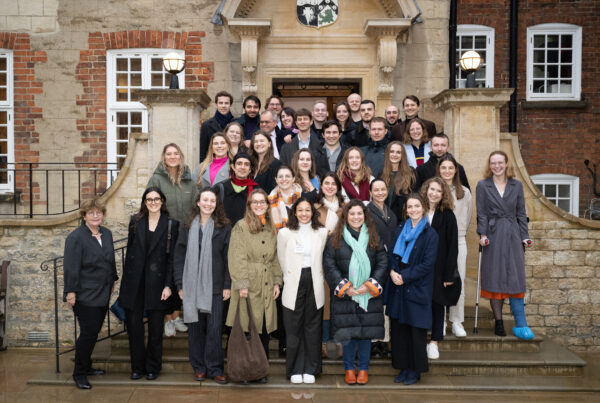
Cohort 2 of the Scholars Programme was due to start with their first module in Oxford this April, but sadly we were not able to hold this as a face-to-face event. We held one smaller and one full-size module online with regular meetings in between, covering topics relating to how Democracy and Ethics are affected by AI and Social Media; Racism & Refugees; the EU and Covid-19; and many more. First steps have also been taken to discuss and develop the group projects which look really interesting so far! We sincerely hope that this group can actually meet in person at some point – with so many countries doing differently well (or badly) handling Covid-19, we need to keep more than our fingers crossed!
Our next module will be online in December.
_______________________________________
ALUMNI
We now have over 570 Europaeum Alumni in our closed Linkedin group and have opened registration on our own website for the Europaeum Alumni Network, hoping that eventually, we can reconnect with almost all of the 1600 alumni we found in our records.
Alumni can keep in touch and be informed about Alumni-related evets and matters in three ways:
• Complete the form on our website to give us permission to have your details securely on file, and we will email you about anything that is relevant to Alumni. Don’t worry, it won’t be too often!
• Join our Linkedin Alumni group if you have a profile. https://www.linkedin.com/groups/13752156/
• Register for our Alumni database https://www.europaeum.org/alumni and search for others by expertise, location, University or Europaeum involvement type/period
Europaeum Alumni are Europaeum Scholars, previous participants at Europaeum events that they attended via an assessed application process, as well as those who received a Europaeum bursary or completed a Europaeum joint degree.
________________________________________
Please send us any relevant items we may be able to include in the next issue.
You are receiving this email because you opted in via our website or because you are an important Europaeum contact at a member university. To opt out please email euroinfo@europaeum.ox.ac.uk or unsubscribe on our website
________________________________________
THE EUROPAEUM
c/o St Antony’s College | 62 Woodstock Road | Oxford OX2 6JF
euroinfo@europaeum.ox.ac.uk
www.europaeum.org
Facebook | Twitter | LinkedIn