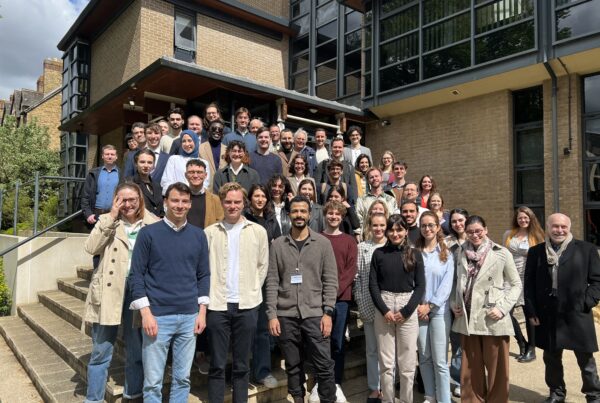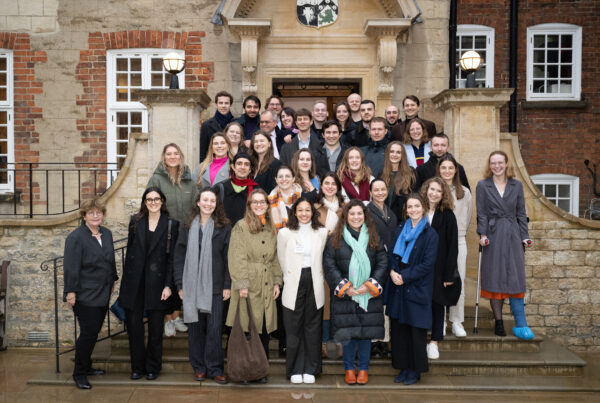
Classics Colloquium, November 2012
Eleventh Classics Colloquium:
Leadership in the Ancient World
University of Oxford
For this year’s Classics Colloquium – the eleventh in its series –, we will look at Leadership in the Ancient World from several angles, including politics, literature, culture, religion, philosophy, history and others.
Classics graduate scholars at member universities of the Europaeum are invited to take part in this Colloquium, which aims to bring young European classics scholars together with leading academic experts, with the chance to present papers for discussion and critique by a fellow scholar.
Programme
Friday 16th November - Lecture Theatre
14.30 Registration
15.00 Welcome and introduction
Dr Paul Flather (Europaeum & Oxford)
Dr Donncha O’ Rourke (Oxford)
15:30 Lecture
Chair: Professor Dimitri El Murr (Paris)
Speaker: Professor Chris Pelling, Regius Professor of Greek, Christ Church (Oxford): How to handle a demos: leadership in Plutarch
Discussants: Laura Tchorz (Bonn), Michal Bizon (Krakow)
16.45 Session II – Leadership And The Other
Chair: Dr Donncha O’ Rourke (Oxford)
- Natalia Tsoumpra (Oxford): Biology matters: female leadership in Lysistrata
- Luigi Prada (Oxford): On the Figure of the Bad Ruler in Herodotus and its Egyptian Archetypes, or De Malignitate Herodoti Revisited
Discussant: Frederick Lauritzen (Bologna)
18.15 Session I – Leadership in Greek Verse
Chair: Professor Emilio Suarez (Barcelona)
- Bob Corthals (Leiden): Nausithous’ Prophecy and Odysseus’ Apologoi
Discussant: Luigi Prada (Oxford)
- Enrica Borsoni Ciccolungo (Bologna): Tyrants' Audacity and Power: the meaning of tolma and dynamis in Thucydides and Pindar
Discussant: Michiel Verheij (Leiden)
- Elodie Paillard (Geneva): An alternative model of leader in Sophocles
Discussant: Simon Weber (Bonn)
Saturday 17th November - First Floor Seminar Room
9.00 Breakfast - Ioannou Centre
9.30 Session III – Philosophical Analysis of Leadership
Chair: Professor Dimitri El Murr (Paris)
- Michal Bizon (Krakow): Philosopher-Kings: freedom and necessity in Plato's political philosophy
Discussant: Gonzalo J. Sanchez (Madrid
- Simon Weber (Bonn): How to Rule a Polis: Aristotle on the Normative Framework of Political Leadership
Discussant: Mateusz Kędzierski (Krakow)
- Esther Rogan (Paris): Leadership crisis in Aristotle’s Politics
Discussant: Laura Tchorz (Bonn)
11.00 Coffee break
11.30 Lecture
Chair: Dr Donncha O’ Rourke (Oxford)
Speaker: Professor Emilio Suarez (Barcelona)
Pindar's Vision of Leadership - a review.
Discussants: Max Eager (Oxford), Bob Corthals (Leiden)
14.15 Session IV – Case-Studies of Leadership
Chair: Dr Donncha O’ Rourke (Oxford)
- Amaranta Martinez Zapatero (Madrid):The Fall of a Hero: The letters of Themistocles
Discussant: Jakub Kuciak (Krakow)
- Pavel Nyvlt (Prague): Leadership from Behind the Curtain: The Case of Antiphon
Discussant: Michal Bizon (Krakow)
15.30 Chair: Professor Emilio Suarez (Barcelona)
- Gonzalo J. Sanchez (Madrid): Chion of Heraclea: A philosopher turned into a tyrannicide
Discussant: Enrica Borsoni Ciccolungo (Bologna)
- Max Eager (Oxford): L. Antistius Vetus
Discussant: Eva Pauerova (Prague)
16.30 Coffee
16.50 Session V – The Historians on Leadership
Chair: Professor Maria Luisa del Barrio Vega (Madrid)
- Jakub Kuciak (Krakow): Herodotus and leadership during Ionian Revolt – distorted image or reliable history?
Discussant: Amaranta Martinez Zapatero (Madrid)
- Mateusz Kędzierski (Krakow): How the empire can save its own power? Metron as nomos physeos in the Thucydides’ ethics and political doctrine
Discussant: Pavel Nylvt (Prague)
- Laura Tchorz (Bonn): Boon and Bane – The ambivalent relationship between leaders and masses in the perception of Polybius
Discussant: Werner de Saeger (Oxford)
18.30 General remarks of the day - led by Dr Donncha O’ Rourke (Oxford)
Sunday 18th November - First Floor Seminar Room
9.30 Lecture
Chair: Professor Maria Luisa del Barrio Vega (Madrid)
Speaker: Professor Dimitri El Murr (Paris)
Title: Farewell to the Shepherd ? Pastorate and Political Leadership in Plato's Statesman
Discussants: Pavel Nyvlt (Prague) and Heta Bjorklund (Helsinki)
11.00 Session VI – Leadership and the Christian Church
Chair: Professor Maria Luisa del Barrio Vega (Madrid)
- Werner de Saeger (Oxford): Leadership in the Ancient World: Constantine, Emperor of Rome.
Discussant: Enrica Ciccolungo (Bologna)
- Frederick Lauritzen (Bologna): Endurance and tribulation: the character of leadership in Psellos
Discussant: Esther Rogan (Paris)
- Eva Pauerova (Prague): Seneca's Tyrants in the Mirror of the Jesuit School Theatre in Bohemia
Discussant: Natalie Tsoumpra (Oxford)
12.30 General Discussion, Conclusions + Future Plans
Dr Paul Flather (Europaeum)and Dr Donncha O’Rourke (Oxford)
List of Participants
Michal BIZON |
Krakow |
PhD, studies in Philosophy |
| Heta BJKORKLUND | Helsinki | Research Assistant |
Enrica CICCOLUNGO |
Bologna |
PhD, Greek Language and Literature |
Bob CHORTALS |
Leiden |
MA, International Relations |
Werner DE SAEGER |
Oxford |
DPhil, Ecclesiastical Architecture and History, |
Professor Maria Luisa DEL |
Madrid |
Universidad Complutense de Madtid |
Max EAGER |
Oxford |
DPhil, Ancient History |
Dr Paul FLATHER |
Oxford |
Secretary-General Europaeum, Fellow, |
Gonzalo JEREZ |
Madrid |
MA, Classic Philology |
Mateusz KEDZIERSKI |
Krakow |
PhD, studies in Philosophy |
Jakub KUCIAK |
Krakow |
PhD, History |
Frederick LAURITZEN |
Bologna |
Post-Doctoral Research Fellow, Fondazione |
Amaranta MARTINEZ |
Madrid |
MA, Classical Philology |
Pavel NYVLT |
Prague |
PhD, studies in Philosophy |
Dr Donncha O’ROURKE |
Oxford |
Corpus Christi College Centre |
Elodie PAILLARD |
Geneva |
PhD, Greek History |
Eva PAUEROVA |
Prague |
PhD, Philology |
Professor Chris PELLING |
Oxford |
Faculty of Classics, Christ Church Oxford |
Luigi PRADA |
Oxford |
DPhil, Egyptology |
Esther ROGAN |
Paris |
PhD Candidate, Philosophy |
Professor Emilio SUAREZ |
Barcelona |
Universitat Pompeu Fabra |
Laura TCHORZ |
Bonn |
PhD, Mass integration in Ancient societies |
Natalie TSOUMPRA |
Oxford |
DPhil, Classic Languages and Literature |
Michiel VERHEIJ |
Leiden |
PhD, Classics |
Simon WEBER |
Bonn |
PhD, Philosophy |
Speaker Biographies
PROFESSOR FRANCESCO CITTI is Chair of the Latin Literature, Latin Language, Tradition and Permanence of the Classics modules at the University of Bologna. He has PhD in Greek and Ancient Philology from the University of Bari. He is also a Member of the International PhD in Civilisation of Humanism and Renaissance (University of Florence - University of Bologna) and a member of the editorial board of the journals Eikasmos, Griseldaonline and Papers on Rhetoric.
PROFESSOR MARIA LUISA DEL BARRIO VEGA is a Professor at Greek Philology and Indo-European Language Department at Universidad Complutense de Madrid from where she obtained her PHD degree in Classic Philology. Her research interest is on Greek Linguistics, especially in dialectology and phonetics (with contributions on onomastics, morphology and Greek Mycenaean and Greek Epigraphy. Her interest on tradition and folklore from Greece led her to found, in 2002, The Cultural Association Rumeli.
PROFESSOR DIMITRI EL MURR is Lecturer in Ancient Philosophy at the University of Paris 1 Panthéon-Sorbonne and a Junior Member of the Institut universitaire de France. His research area is ancient philosophy, especially Socrates and Plato. He has launched in 2010 a four-year long research project on Socrates and the Socratics, funded by the French Agence nationale de la Recherche. He is currently writing a monograph on Plato’s Politicus.
DR. PAUL FLATHER is Secretary–General of the Europaeum, an association of leading European Universities, and Fellow of Mansfield College, Oxford. He was the founding Secretary-General of the Central European University (1990-1994) originally set up in Budapest, Prague, and Warsaw by George Soros, and director of international and external affairs for Oxford University (1994-1999). Formerly, he worked at the BBC, Times Newspapers, and served as Deputy Editor of the New Statesman. His research work is on Indian political development since Independence. He has worked with dissident movements in Central Europe in the 1980s, and with race equality groups in the UK. He was an elected member of the London Council in the 1980s (chairing its committee on post-school education 1986-1990). He currently chairs the Noon Scholarship Committee, and is on the board of the Roundtable. He studied at Balliol College, Oxford.
DR DONNCHA O’ROURKE has been a British Academy Postdoctoral Fellow in Classics at the University of Oxford, Corpus Christi College, since 2010. Previously, he held research and lecturing positions at Trinity College, Dublin, where he completed his doctoral thesis in 2008. This is shortly to be published by Cambridge University Press as Propertius and the Virgilian Sensibility; he is also the author of several published or forthcoming articles on intertextuality in Augustan poetry. His current research concerns the reception of Lucretius in the genre of Roman elegy.
PROFESSOR CHRIS PELLING is the Regius Professor of Greek at Oxford University and a Fellow of the British Academy. He is former President of the Hellenic Society (2006-8) and also former President of the International Plutarch Society (2008-11). His research interests range over Greek and Latin historiography and biography, and also over other areas of Greek literature, especially tragedy.
PROFESSOR EMILIO SUAREZ is a professor of Greek Philology at Universitat Pompeu Fabra (Barcelona). He has taught in several Spanish universities and has not only published four books on ancient Greek lyric poetry and, but also taken part in a vast range of national and international academic publications on Greek religion and literature. He is the President of the Spanish Society for Religious Science, member of the Editorial Council of Kernos, International and Multidisciplinary Review of Ancient Greek Religion and of the Advisory Boards of severalinternational periodicals. He is also member of several International Societies.
Abstracts
MICHAL BIZON
Philosopher-kings: freedom and necessity in Plato's political philosophy
The paper is a study of the notion of freedom (eleutheria) and necessity (anankē) in the political philosophy of Plato. Drawing mainly from the Hippias Minor, Gorgias and Republic IV, VIII and IX it lays out the development of the idea of freedom as a moral notion originating in Socratic thought as opposed to sophistic ethics, which then acquires ontological backing through the moral psychology of Republic IV, and is finally employed in the political philosophy of Republic VIII and IX.
The Hippias Minor serves as a starting point, where a simple version of sophistic ethics, which does not distinguish between act and intention leads to a paradoxical notion of the good intentional wrongdoer. The difficulty thus posed is solved on moral psychological grounds in the Gorgias with the distinction of wanting (boulesthai) and merely thinking, that one wants. This allows for the introduction of the notion of motivation as opposed to action. Further, the notion of freedom is introduced as a congruity of motivation and action. This concept is then applied to political theory, with the philosopher and tyrant occupying polar opposites on the scale of freedom.
Republic IV supplies an ontological foundation for the notion of freedom through the tripartite psychology, which assumes independent motivations deriving from each part ordered hierarchically (with the logisticon as the source of the highest kind of motivation). The moral notion of freedom from the Gorgias is elaborated within this ontological framework as the congruity of action with motivation supplied by the logisticon, which is a direct consequence of psychic harmony (a harmonious soul always acts according to the logisticon).
This elaborated concept of freedom is again applied to political theory. Republic VIII and IX describe five constitutions ordered according to the degree of freedom, primarily as regarding the soul of the ruler, and only secondarily the political freedom of citizens (there is however a strong correspondence between these notions due to the soul-state analogy). Here a limitation of Plato's theory of freedom is apparent. Although there is a clear distinction between freedom as a concept of moral psychology and political freedom (the distinctive feature of the democratic constitution), both concepts are termed eleutheria. Their distinction however is manifest in the fact that freedom is for Plato the essential feature of democracy, and yet this constitution is second lowest in the hierarchy of freedom, ranking higher only from tyranny, which is called the most un-free (aneleutherotatos).
The final part of the paper deals with the notion of necessity as regarding the above outlined political theory. As described at the beginning of Republic VIII the fall of the philosopher-king, which initiates the declining evolution of constitutions is eventuated by a miscalculation of the nuptial number, which happens by necessity aisthēsei or logismōi. Thus freedom as congruity of act and motivation, being a consequence of psychic harmony and a defining feature of the philosopher is itself subject to a necessary principle of corruption. It is argued that this insufficiency of freedom (and of virtue to uphold itself) may be interpreted as a platonic counterpart of primordial sin (which in the platonic system is synonymous with the incarnation of the ideal), i.e. an inherent corruption of human nature, which thus requires external support to sustain a virtuous existence.
ENRICA CICCOLUNGO
Tyrants’ Audacity and Power: the Meaning of tolma and dynamis in Thucydides and Pindar
In his brief reference to the extraordinary power reached by the Sicilian tyrants (Thu. I. 17), Thucydides seems to find its causes in a capacity to act (dynamis) and in a go-aheadism (tolma) of which to them contemporary Greece seems to be free; by the time Thucydides lives, these two attitudes have been laying the foundations of the great power of Athens. In a very different context, Pindar perceives in the same two concepts the ultimate skills that both poet and laudandus must have to gain glory in their respective fields of action. The exaltation of tolma and dynamis,with all the risks and benefits they imply, becomes absolute when the principal of the ode is a monarch or a tyrant: this is particularly noticeable in the poems dedicated to Hiero of Syracuse, in which the sovereign’s profusion of efforts both in agonistic and political enterprises is as effective as possible.
BOB CORTHALS
Nausithous’ Prophecy and Odysseus’ Apologoi
Nausithous’ prophecy in Odyssey 8.564-71 that Poseidon will one day punish the Phaeacians for providing convoy to strangers seems to cause two serious narrative inconsistencies: why does Odysseus admit to the Phaeacians that his failure as a leader incurred him the wrath of Poseidon? And why, in turn, are the Phaeacians still ready to accommodate Odysseus’ return home after learning about the enmity? This paper suggests that the prophecy functions as part of the primary narrator’s effort to ensure the reliability of Odysseus’ subsequent first-person narratives, and attempts to show that the hero’s privilege of singing his own kleos comes at a price: inclusion of his failed leadership in the Kyklopeia which brought about Poseidon’s hostility.
WERNER DE SAEGER
Leadership in the Ancient World: Constantine, Emperor of Rome.
Of all Roman history, the 4th century AD is the one that had the most profound impact on Western liberal democracies. The political leader responsible for those changes is Constantine the Great, first Roman Emperor to have converted to Christianity. His changes in law, policymaking, the distribution of power, theology, and architecture, have changed our world forever. Discussing Constantine’s leadership therefore is an immense undertaking, yet this presentation will without essentializing focus on several crucial elements of Constantine’s decisions and actions. Constantine’s leadership is most visisble today in the triplicity of law, theology, and architecture.
After a brief overview of the events of October 312 (exactly seventeen centuries ago) which led Constantine to opt for the Christian faith, I shall specifically argue the multifaceted nature of his leadership: the changes in architecture would not have happened without the evolutions in law and theology, and vice-versa. In this polyparadigmatic perspective, it is of the utmost importance to both look at a detailed timeline and at the various stakeholders present in the power struggle of Late Antiquity Rome.
The legalisation of Christianity, which started with the conversion of Constantine, found its first legal expression in the Edict of Milan. This edict is said to be one of the earliest implementations of true religious liberty in the Western world – but was it really? And how did Constantine’s consequent building policy reflect his newly found faith? How did the topography of sacred architecture in Rome express the power struggle between the traditional Roman senatorial families and the Christian communities, led not just by their bishops but by Constantine and his court in the first place? I shall furthermore point to the Sunday Rest law which opened a new perspective on the day of rest and which gave Christians a moment to go to Church. Churches then had to be built to accommodate the growing communities of faithful. All of these initiatives can be directly traced back to Constantine.
Constantine’s leadership may have started with the powerful and straightforward legal decisions he made. A part from the Sunday Rest law, he mixed Church and State to such a degree that we currently still don’t know how to implement the ideal equilibrium in the 21st century West – there even isn’t an ontological consensus, namely on whether such an equilibrium exists. Constantine didn’t merely focus on theoretical debates, he subsidised priests and sponsored church architecture, and gave legal powers to bishops. Yet the theoretico-ideological aspects weren’t fully absent: he organised the Council of Nicaea, a meeting of Christian bishops, to end theological controversies and to unify the Church - and thereby, according to some intellectuals, his Empire.
In a sense, Constantine’s leadership was exemplified best by the ensemble of decisions he made in favor of Christians, yet he did much more than that. Spiritual, legal, and policymaking initiatives made Constantine the leader Rome needed at a moment of crisis. But imprivisable as it was in the first half of the fourst century AD, it led to strife and enmity later on, not in the least during the reign of Theodosius.
My presentation will look at Constantine’s leadership from a multidisciplinary perspective and provide the audience with fresh insights both into his conversion (as I shall present a yet unpublished analysis on the topic) and on his subsequent extraordinary decisions which were examples of courage, intelligence, and audacity.
MAX EAGER
L. Antistius Vetus
Following the failure of Piso’s conspiracy in 65 ad certain individuals were singled out for execution. Some targets were obvious; others not. Despite Tacitus’ characterization of the farraginous plotters, the Palace can be shown to have extrapolated an archetypal figure, around whom it was feared more military men could rally. Of those embroiled in the fallout of Annales XVI, L. Antistius Vetus stands apart from the others. In contrast to Cassius Longinus and his nephew L. Torquatus, Vetus is a near nonentity. This paper will explore Vetus’ capacity as a ‘resistance-leader’ and why Tacitus might have omitted these facts.
GONZALO JEREZ SANCHEZ
Chion of Heraclea: A philosopher turned into a tyrannicide
Our aim is to discuss freedom, defined from the point of view of a value the importance of which is manifested when one is deprived of it. So, we have chosen a collection of seventeen epistles known as Chion's letters, probably from 1st century A.D. Their author deals with our subject in two of them, analyzing how hatred for tyrants makes us value freedom. We can easily find other literary examples on this topic, also worthy for in-depth analysis. Are these works about the death of tyrants, about values of freedom, or just products of rhetorical schools´ work?
FREDERICK LAURITZEN
Endurance and tribulation: the character of leadership in Psellos
Book 3 of the Chronographia written by Michael Psellos (1018-1081) describes how the emperor Romanos III (1028-1034) endured physicalsuffering as well as a hostile court, while believing he was a philosopher king. His model was the stoic emperor Marcus Aurelius (161-180). The short reign was important from the point of view of culture and literature. However one may perceive in the literary dynamics of the time, the dependence on the virtues and vices of those with political power and thus illustrate the nature of leadership.
MATEUSZ KEDZIERSKI
How can the empire save its own power?
In my speech I will concern, from the perspective of Thucydides’ politics and ethics, the determinants of the evolution of the Athenian empire that brought democratic polis to defeat and collapse. I will raise (and explain) the questions on the nature of Thucydides’ metron , nomos physeos and their mutual relations; and why it is extremely important in the context of political wisdom.
Next, I will briefly juxtapose Athenian empire with British and American modern empires trying to highlight common principles for the ancient and modern superpowers to save their own power avoiding hatred and envy.
AMARANTA MARTINEZ ZAPATERO
The fall of a hero: The letters of Themistocles
Themistocles was one of the most important governors that classical Athens gave birth to and a rather controversial figure. From the favour of his fellow citizens to ostracism, he tasted the bittersweet flavour of power.
Several authors, such as Thucydides, Plutarch or Lucian inform us about Themistocles’ political activities and different aspects of his life. Among these ancient sources, it is particularly interesting to look at the so-called Letters of Themistocles, which are claimed to be fictitious. They relate in a rather novelistic way the events that occurred after the fall of this eminent Athenian politician.
PAVEL NYVLT
Leadership from Behind the Curtain: The Case of Antiphon
The lecture is planned to be preoccupied with two sentences from Thucydides (8.68.1-2). The historian, coming to the Athenian oligarchic coup in 411, stops his narrative in order to offer his readers a brief sketch of the most important conspirators, with Antiphon in the first place. Antiphon is there praised for his intelligence and credited with planning the whole oligarchic conspiracy. The historical reliability of the passage has recently been attacked by Prof. M. J. Edwards (Antiphon the Revolutionary, in: Law, Rhetoric and Comedy in ancient Athens, Swansea 2004, pp. 75-86). Edwards argues Thucydides‘ testimony is contradicted by his description of events leading to the putsch and that it is less reliable than a papyrus fragment of Antiphon’s self-defence speech, pronounced on a trial which led to his execution. The lecture would argue for the retention of traditional evaluation of Thucydides‘ reliability and Antiphon’s role in the coup.
Alcibiades: Athenian renegade, mover of the Athenian expedition to Sicily, then exiled, in 412-411 in Persia, recalled back by Samian oligarchs, went to exile again in 406. Antiphon is said to have written an Abuse of Alcibiades. Killed in Persia in 404/3.
Androcles: a democratic politician, enemy of Alcibiades, killed in 411 before the revolution.
Andron: a member of Four Hundred, one of Antiphon’s prosecutors.
Antiphon: an orator, radical oligarchic politician in 411, perhaps identical with a homonymous sophist. Member of an embassy to Sparta, executed by the Athenians.
Apolexis: a member of Four Hundred, one of Antiphon’s prosecutors.
Aristocrates: a moderate oligarch, who led a rebellion against the rule of Four Hundred. Executed in the aftermath of battle of Arginusae.
Brasidas: an excellent Spartan general, killed in 422.
Cleon: an Athenian democratic politician, killed in 422.
Clitophon: according to pseudo-Aristotle, an author of an amendment to Pythodorus' decree.
Hermocrates: a Syracusan general, who played an important role in defeating the Athenian invasion on Sicily. Exiled from Syracuse, he tried to return, but was killed in a street fight in 407.
Laespodias: a not-very-successful Athenian general, target of one Antiphon’s speech, member of first embassy to Sparta in 411.
Melobius: according to pseudo-Aristotle, an advocate of oligarchy in 411. Later one of the “Thirty tyrants”.
Nicias: originator of peace between Sparta and Athens in 421, leader of Athenian expedition on Sicily, executed by the Syracusans in 413.
Peisander: the man who did much of the business on an open stage: negotiated with Alcibiades, persuaded the Athenians to consider a possibility of sacrificing democracy in order to obtain Persian finance, urged the oligarchic clubs to cooperate, unsuccessfully negotiated with Persia, according to Thuc. formally proposed to entrust the state to the Four Hundred. Fled after the insurrection against oligarchy.
Peisistratus: an Athenian tyrant in 6th century, father of Hippias and Hipparchus. Hipparchus was killed, Hippias exiled.
Phrynichus: an enemy of Alcibiades, Antiphon’s friend in 422, turned to oligarchy once the oligarchs dissociated themselves from Alcibiades. Member of an embassy to Sparta along with Antiphon, stabbed to death on his return to Athens.
Pythodorus: according to pseudo-Aristotle, mover of a decree to establish oligarchy of Four Hundred. Diogenes Laërtius credits him with prosecuting Protagoras the sophist for teaching for money.
Theramenes: a moderate oligarch, who helped to create the oligarchy of Four Hundred and then led a rebellion against it. One of Antiphon’s prosecutors. Executed in 404 by an oligarchic régime of “Thirty tyrants”.
Tissaphernes: Persian satrap of Lydia (SW Asia Minor).
ELODIE PAILLARD
An alternative model of leader in Sophocles
In Ajax and Philoctetes, Sophocles provides an alternative leadership model through his staging of Odysseus. This paper examines how Odysseus’ ways of dealing with difficult situations and of leading others fundamentally differ from previous models of aristocratic leaders. For example, he shows himself in both plays to be prepared to face the (real or supposed) hatred of others and proves able to overcome it in order to let his opinion and leadership triumph. Parts of his discourse to Neoptolemus at vv. 54 ff. in the Philoctetes are comparable to ideas attributed to Pericles by Thucydides at 2.64 ff. The staging of Odysseus problematizes the role of ‘leader’ in a democratic context both by promoting a new model and by questioning it.
EVA PAUEROVA
Seneca’s Tyrants in the mirror of the Jesuit School Theatre in Bohemia
This paper will focus on the character of the tyrant, omnipresent in Seneca’s tragedies, which obviously appears as well in the Latin Jesuit school theatre - intended as a means of education - of the Bohemian province. In both Seneca and Jesuit’s plays, written by teachers for their students, one can find a hero standing against the tyrant. A hero ready to pay for his opinion/belief with his own life, the death being considered as a decent way to stand firm and to oppose the evil, not as a reason for sadness or regrets. The controversy of these characters will be studied mainly on the examples of Hercules Furens and Arnoldus Engel’s (1620-1690) Costis sive Catharis Partheno-Martyr Alexandrina... existent in two manuscripts kept in Prague libraries (dated 1655 and 1656).
LUIGI PRADA
On the Figure of the Bad Ruler in Herodtus and its Egyptian Archetypes, or De Malignitate Herodoti Revisited
The tradition of the bad ruler, in particular that of the Oriental despot, intemperate, impious towards the gods, and cruel towards his subjects, has long tradition in classical authors. Famous such figures appear in Herodotus’ second book. Since antiquity, much of Herodotus’ account has been suspected of being the creation of his imagination. But in recent years, previously unknown Egyptian narrative texts, particularly in Demotic, have been published, which present perfect parallels to Herodotus’ version. This paper will focus on three figures of bad or less than perfect rulers, Amasis (the drunkard), Cheops (the tyrant) and Pheros (the impious), comparing their stories in Herodotus’ rendition and in the original Egyptian sources.
LAURA TCHORZ
Boon and Bane – The ambivalent relationship between leaders and masses in the perception of Polybius
“But as every multitude is fickle, full of lawless desires, unreasoned passion, and violent anger, the multitude must be held in by invisible terrors and suchlike pageantry.” Polybius’ opinion on multitudes of persons was not untypically in his time. Ancient Greek historians, exclusively from the social elite, were dominated by a certain fear and they structured politics as antagonism of leading characters on one side and the crowd on the other.
This presentation will underline the specific relationship between leaders and their recipients in the books of Polybius. In order to get a clear image of Polybius’ idea of leadership, first it is important to show how he describes a leader: what it is in his eyes important and should be mentioned about a person who leads a certain group. However not only the active description of characters is useful, even the theoretical chapters on statecraft and military formation provide practical information about leadership. Secondly, I will analyse Polybius’ biased characterization of the multitude of people and of their behaviour, before concluding with a consideration of the interaction of both parts.
But even more revealing than the regular action and behaviour of leaders and multitudes are extraordinary situations, when the crowds are getting out of control. Especially the leader´s reactions at a societal turning point, when a crowd or multitude (e.g. soldiers, warriors or citizens) changes into a mass, are used by Polybius to characterize a leader in historiography: the critical situation would demonstrate the real qualities of a commander, taking action. Therefore I argue that the description of collective behaviour acts as an indicator for the appraisal of leader’s actions and reactions respectively the success or failure of leadership. Polybius, with other words, despises the masses and criticizes their behaviour. But on the other hand he employs the description of the masses as a useful tool to evaluate political leadership.
NATALIE TSOUMPRA
Biology matters: female leadership in Lysistrata
In this paper I examine the dynamics between manipulation of power and sexual identity in Lysistrata and I suggest that women manage to ascend to power based on their tradition role as wives and mothers. Women’s claim to leadership soon takes on a more serious tone than the initial sex strike, as they threaten men (and the city) with sterility and cessation of reproduction. This is emphasized in the scene of the old women-guards dousing men. The association of women with water lies close to Hippocratic and Aristotelian theories, which connect the excessive moisture of the female body with the feeding breasts and the fertile womb. This reading of the scene supports the argument for a female leadership based on the legitimate rights of the women as wives and mothers in the play.
SIMON WEBER
How to Rule a Polis? –Aristotle on the Normative Framework of Political Leadership
Beginning with the early modern natural right theorists and the rise of political liberalism in the 18th and 19th century, we are used to commit the legitimacy of political rule and leadership to the granting and enforcement of the rights of the individual. Unfortunately, this very attractive way of thinking about the legitimacy of political rule and leadership is often denied for ancient philosophy (see, for example, Constant, Hegel). But what, then, is the normative framework of political rule and leadership in antiquity? In my paper, I will pursue this question with respect to Aristotle’s Politics. I will show that Aristotle’s revolutionary innovation in thinking about the legitimacy of political rule and leadership is the normative figure of the naturally free man (physei eleutheros). This naturally free man owns the (moral and legal) status of being an end in itself, insofar as he exists not for another person (mê allou esti) but for his own sake (autou esti) – in opposite to the natural slave (physei doulos) who exists not for himself (mê autou esti) but for another person (allou esti). Thereby, the status of the natural free man as being an end in itself becomes the hallmark of legitimate political power, which is rule over free persons, and the criterion for good constitutions of poleis (see Pol. 3.6-7). I will argue that, considered in this broad sense, the emergence of the early modern natural right theories has, to be read as the legacy rather than the abandoning of the ancient-Aristotelian tradition.
Abstract:
What is the normative framework of political leadership in antiquity? In my talk I will pursue this question with respect to of Aristotle’s Politics. I will show that Aristotle’s revolutionary innovation in thinking about the legitimacy of political leadership is the normative figure of the naturally free man (physei eleutheros). This naturally free man possesses the status as being an end in itself and becomes, thereby, the hallmark of legitimate political power. In this broad sense, the emergence of the early modern natural right theories has, therefore, to be read as the legacy rather than the abandoning of the ancient Aristotelian tradition.