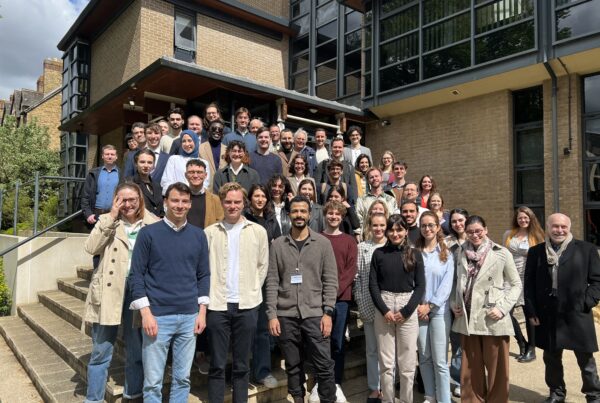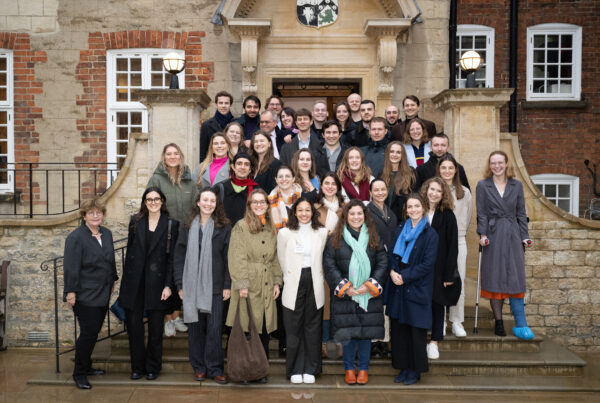
Classics Colloquium, November 2007
Sixth Classics Colloquium:
Myth, Culture, Society: Europaeum Classics Colloquium in memory of Jean-Pierre Vernant
University of Oxford
23-24 November 2007
Conference Coordinator: Professor Stephen Harrison, Professor of Classics, University of Oxford
Jean-Pierre Vernant (1914-2007) was a towering figure in the field of classics, both in his native France and internationally. The citation for his honorary doctorate at Oxford in 1999 reads as follows: 'A scholar of great learning, whose work has illuminated early Greece, and a man who has served his country with great distinction.'He was educated at the Sorbonne. Having commanded the Resistance Forces of SW France under the pseudonym 'Colonel Berthier', he taught Philosophy at lycées in Toulouse and Paris before working at the Centre National de la Recherche Scientifique from 1938. From 1957 to 1975 he was Directeur d'Etudes at the Ecole Pratique des Hautes Etudes. He then held a professorship at the Coll√®ge de France until his retirement in 1984.In 1964 he founded the Centre de Recherches Comparées sur les Sociétés Anciennes (Centre Louis Gernet) in Paris. His books are seminal works on ancient Greece, and he was a leader in the movement to combine literature, history and anthropology. His many significant publications, frequently translated into English and other languages, include Les Origines de la Pensée Grecque (1962), Religions, Histoires, Raisons (1979) and Entre Mythe et Politique (1996).
This colloquium will combine some reflection on Vernant's crucial contribution to the discipline of classics by leading scholars in his field with a broader exploration of the topics investigated in his scholarly work, under the headings of myth, culture and society. Following the normal mode of Europaeum conferences in classics, there will be a combination of papers by established scholars and papers by graduate students. Papers can be offered under any of the headings 'Myth', 'Culture' and 'Society', preferably combining more than one of these three elements in honour of Vernant's own highly interdisciplinary work, and covering any topic in the literature and culture of pre-Byzantine Greece and Rome.
Programme
All sessions will take place at the Ioannou Centre for Classical and Byzantine Studies, 66 St Giles, Oxford OX1 3LU, Tel. +44 (0) 1865 288391
Friday 23rd November
ARRIVALS – Participants should check-in at their College accommodation by 16.00
16.30 Registration at Classics Centre
17.30 WELCOME
Professor Stephen Harrison (Oxford); followed by Professor Robert Parker (Oxford), on Jean-Pierre Vernant (and Marcel Detienne) on ‘la société des dieux’
Saturday 24th November
[All papers 20 minutes, all responses 5 minutes]
9.30-11.00 SESSION 1
-
1: Andrea Harbach (Geneva): The judgement of Paris: myth and moralising
2: Response
3: Silvia Porres Caballero (Madrid): The Vengeances of Dionysus
4: Response
5: Sanna-Ilaria Kittelä (Helsinki): Queen craving for power. Aeschylus’ Klytaimestra
6: Response
-
7: Irene Pajón Leyra (Madrid): Symposium and diffusion of learning in the Hellenistic world.
8: Response
9: Marcela Slavikova (Prague): Pseudo-Plutarch’s Dialogue On Music - a Compilation or a Literary Work?
10: Response
11: Matias Buchholz (Helsinki): Questions to Oracles in Graeco-Roman Egypt: The Papyrological Evidence
12: Response
-
13: Julie Cerna (Prague): Valerius Maximus and the Nobility of His Time
14: Response
15: Dr Antonio Ziosi (Bologna): Myth, history and tragedy for a modern epic
16: Response
17: Davide Antonio Secci (Bologna): Evander’s tale of Hercules and Cacus in Aen. 8: how to tell a story, how to write an epic
18: Response
19: Roswitha Simons (Bonn): Why myth? The use of pagan myth by Christian poets of the 5th - 6th centuries.
20: Response
17.30-18.00 CONCLUSIONS
Abstracts
Andrea Harbach, University of Geneva
The judgement of Paris: myth and moralising
Both in ancient philosophy (e.g. Chrysippos, Proclos) and in modern research (e.g. Merkelbach, Davies), a reading of the myth of the judgement of Paris has been suggested which considers it rather as a choice between different lifestyles than as a beauty contest. An examination of three of the surviving versions of the story reveals the presence of topoi traditionally associated with situations in which a character has to make a choice between different ways of life: Euripides converts it into a stark choice between an inactive and an active lifestyle; Apuleius summons up a large variety of elements from the story of Heracles at the crossroads; Lucian even includes in Aphrodite's promises aspects of the contrast between city and country.
[R. Merkelbach: 'Achill, Herakles und Paris. Oder: Innere und äußere Motivierung bei den Griechen', 1-16 in: R. Merkelbach, Hestia und Erigone. Vorträge und Aufsätze, Stuttgart/Leipzig 1996; and, M. Davies: 'The judgement of Paris and Solomon', in: Classical Quarterly 53 (2003) 32-34.]
Silvia Porres Caballero, Universidad Complutense de Madrid
The Vengeances of Dionysus
The Greek Lyric Poets never allude to a negative attitude in Dionysus. None of them writes about his vindictive character and the god of wine is never criticised for blameworthy or terrifying conduct, but we can infer it from the fact that his vengeances appear in the scanty number of myths narrated in the lyric poetry. In the myth whose subject was the daughters of Minyas’ punishment, and, perhaps, in Actaeon’s myth, Dionysus punishes those worthy of it : therefore the god is not vindictive, but a right god, who rewards good behaviour and punishes bad acts.
Sanna-Ilaria Kittelä, University of Helsinki
Queen craving for power. Aeschylus’ Klytaimestra
In my paper I will discuss some problems in the (feminist) readings of Aeschylus’ play Agamemnon, focusing in particular on the figure of Klytaimestra. Many scholars have regarded the male-female conflict as this play's main issue, raising the question of Klytaimestra's ability to act as an autonomous female moral agent, as well as the problem of judgement in the case of regicide made by a woman. However, these readings are problematic: Klytaimestra’s role has been interpreted through modern perspectives, enforcing upon the ancient poet’s text present-day ethical and ideological values. I will suggest a different kind of approach to Aeschylus’ text: Klytaimestra and her crimes should be considered from the poet's own frame of reference as well as from the point of view of the contemporary Athenian society. I include in this discussion some observations on women’s position in 5th century Athens. As a case study I examine the role of Klytaimestra in the play production The Atrides (Topos Allou Theatre, Athens, summer 2007).
Irene Pajón Leyra, Universidad Complutense de Madrid
Symposium and diffusion of learning in the Hellenistic world
The beginning of the Hellenistic period means a deep transformation of the symposium institution, the field where the ruling class always played its part. Once the figure of the king centralises the power, political discussion, indispensable before, loses its meaning as the key feature of convivial encounters, and the rise of rich traders and high officers to the favoured sector of society endangers the exclusive character of this practice, long the distinctive symbol of the elite. Learning must, then, replace politics as the centre of the conversations, and showing erudite knowledge becomes essential to everyone that wants to be respected among the powerful. For this reason, it is at this moment when for the first time we find properly popularising scholarly literature, directed to guarantee an appearance of erudition, the key to social success.
Marcela Slavikova, Charles University, Prague
Pseudo-Plutarch’s Dialogue On Music - a Compilation or a Literary Work?
Among a dozen ancient Greek treatises on music that are preserved, the anonymous dialogue On Music, once ascribed to Plutarch of Chaironeia, tends to attract special attention which usually results in its early translation. What are the motives of translating a work whose author earned a nickname of “a stupid compiler”? What are the reasons for its permanent popularity? Can this “mere compilation” be called a literary work?
Matias Buchholz, University of Helsinki
Questions to Oracles in Graeco-Roman Egypt: The Papyrological Evidence
The Egyptian soil has preserved a fair number of papyri containing questions to oracles. For the Graeco-Roman period, there are more than 100 published texts written in Greek, Demotic and Coptic. Do these texts allow us to draw a reliable picture of the role and the functioning of oracles in Graeco-Roman Egypt? In my paper, I will argue that the chronological, regional and linguistic distribution of the papyri suggests that oracles played an important role in Egyptian society throughout the period discussed, but that there are many questions which the papyrological material leaves unanswered.
Julie Cerna, Charles University, Prague
Valerius Maximus and the Nobility of His Time
In my paper, I will be dealing with the question of Valerius Maximus’ audience and its social status, touching the today much discussed problem of the purpose of his writing: was it intended to serve only as a handbook for rhetoricians and lawyers, or can we envisage it also as a book used for private reading, or even public recitation?
Dr Antonio Ziosi, University of Bologna
Myth, history and tragedy for a modern epic
In his inclusive 'Epische Technik' Virgil, as has been pointed out since the ancient commentators of the Aeneid, accommodates different genres and aetiological themes within his poem in order to create a modern Roman (civic) epic. Among other important examples, Book 4 has often been analysed for its debts (mediated by Hellenistic and Neoteric poetry) to Attic tragedies of love, furor and desertion. This relationship, however, is not merely intertextual and structural: the mythological legends which form the basis of Book 4 and, indeed, the 'historical' (or 'Naevian') function of Dido are also fraught with tragic elements, i.e., in Vernant's terms, with the mythical conflicts that provide the foundation of 'the City', its community and its hegemony.
Davide Antonio Secci, University of Bologna
Evander’s tale of Hercules and Cacus in Aen. 8: how to tell a story, how to write an epic
In book 8 of the Aeneid, Evander proceeds to relate the story of Hercules’ fight with Cacus as the aition of the rites in honour of Hercules established by his contemporary priest Potitius. Evander’s narrative raises a series of questions, mostly related to the underlying compression of the generational gaps between him, Aeneas and Hercules: a) whereas Evander presents his people (if not himself) as eye witnessing the fight, other elements of his story seem to transpose it into the far past; b) whereas Potitius is presented by Evander as the founder of the rites he subsequently appears in front of Aeneas as leading the celebrations in honour of Hercules; and, c) Cacus’ monstrosity and underworld qualities are somehow inconsistently paired with cunning, swiftness and, overall, Mercurial traits. As will be argued, the fictive elements of what is presented by Evander to be a historical narrative might reflect the very process and inconsistencies of Vergil’s own mythmaking.
Roswitha Simons, University of Bonn
Why myth? The use of pagan myth by Christian poets of the 5th - 6th centuries.
The use of pagan myth in late antique Latin literature by authors whose Christian belief is beyond doubt is often characterised as wholly conventional and is attributed only to their education and the heritage of a long literary tradition; it served their self-fashioning as well-educated and cultivated Romans in a time of weakness of the Roman Empire. However, an analysis of the works of some of these authors (Sidonius Apollinaris, Dracontius, Ennodius) gives evidence that their ways and their intentions of using myth differ widely and that the common explanation is inadequate.